
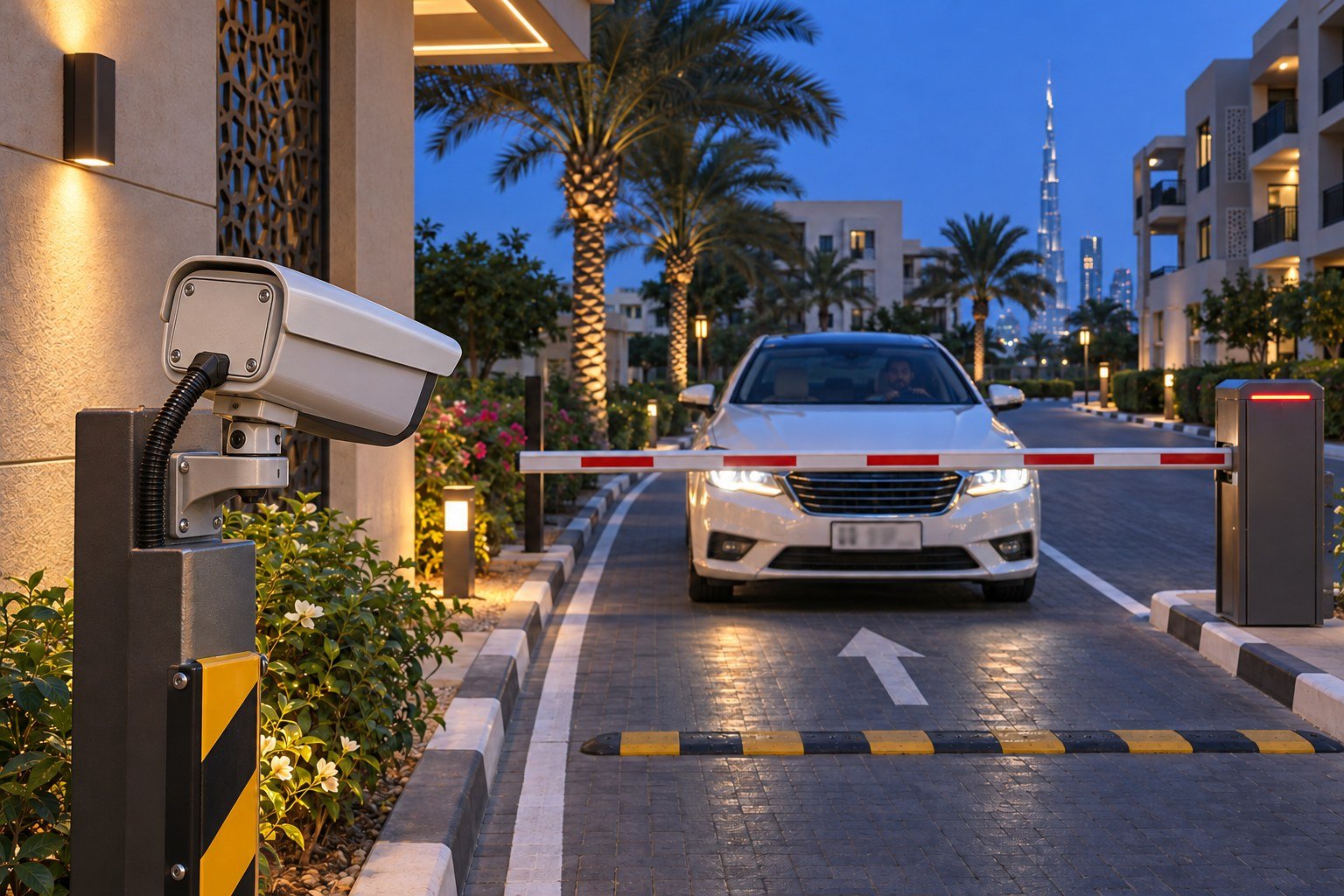
An ANPR camera reads a vehicle’s number plate and lets your access control system decide, in a second or two, whether to lift the barrier. For UAE car parks, residential compounds, warehouses and staff entrances, it removes the need for remotes, tickets and cards at the gate. This guide explains how ANPR works, how it connects to a boom barrier, where to install the camera and when you should pair it with a second credential.
What is an ANPR camera?
ANPR stands for automatic number plate recognition. An ANPR camera captures an image of a vehicle’s plate and uses optical character recognition (OCR) software to turn it into text. The same technology is also called ALPR or LPR. As manufacturer Milesight explains in its ANPR camera guide, the terms differ mainly by region, not by how the system works.
Unlike a normal CCTV camera, an ANPR camera is built for one job: getting a sharp, readable image of a plate. That is why it usually has its own infrared illuminator, a fast shutter and recognition software tuned to plate formats. Standard surveillance cameras can record a vehicle, but they are rarely reliable at reading the plate.
How ANPR vehicle access control works
A typical entrance works in five steps:
- Detection. A vehicle arrives at the barrier. A ground loop, a sensor or the camera’s own video analytics detects it.
- Capture. The ANPR camera takes one or more images of the plate.
- Recognition. Software on the camera or on a server reads the characters.
- Decision. The plate is checked against an allow list of residents, staff or pre-registered visitors, and a block list if you keep one.
- Action. If the plate is allowed, a relay output opens the barrier and the event is logged with a time-stamped image. If not, the barrier stays down and a guard or intercom takes over.
Our parking barriers, such as the UT-BMG-3005 parking boom barrier and the UT-BMG-3007 boom barrier gate, are designed to work with ANPR triggers alongside loops, remotes and card readers. You can see the full range in our boom barriers and parking category.
Camera-based or software-based decisions
There are two common ways to set up the decision step:
- On the camera. Many access-type ANPR cameras store an allow list and switch a relay themselves. This is simple and works well for a single gate with a stable list of vehicles.
- In software. The camera sends the plate to an access control or parking management platform, which makes the decision. This suits sites with several entrances, visitor booking, paid parking or reporting needs, because the list and the logs are managed in one place.
ANPR vs other vehicle credentials
ANPR is not the only way to identify a vehicle at a gate. Here is how it compares with the other common options:
| Credential | What the driver does | Main strength | Main weakness |
|---|---|---|---|
| ANPR camera | Nothing | No cards or tags to issue | Reads can fail on dirty, damaged or obscured plates |
| UHF windscreen tag | Nothing | Reads at several metres, regardless of light | Tags must be issued and managed |
| Proximity card reader | Presents a card at the window | Low cost, familiar | Driver must stop and reach out |
| Remote control | Presses a button | Simple for small sites | Remotes are easily shared and hard to audit |
For a closer look at card and tag technologies, including UHF tags, read our RFID card guide.
Where ANPR works well in the UAE
- Residential compounds and villa communities: residents drive in without remotes, and visitor plates can be pre-registered.
- Office and staff car parks: the allow list follows HR changes, so leavers lose access without collecting a card.
- Warehouses, logistics yards and industrial sites: every truck movement is logged with an image.
- Hotels, malls and commercial parking: ANPR can support ticketless entry and exit when linked to a parking management system.
Installing an ANPR camera: practical tips
Most ANPR problems come from placement rather than the camera itself. Keep these points in mind:
- Straight approach, low speed. Position the camera where vehicles approach in a straight line and slow down, ideally a few metres before the barrier.
- Angle. Keep the horizontal and vertical angles to the plate as shallow as the manufacturer recommends. Steep angles distort the characters.
- Sun and glare. In the UAE, low morning and evening sun can shine straight into the lens or bleach the plate. Check the sun’s path at your entrance before you fix the mounting position.
- Heat and dust. Use an outdoor-rated housing suited to the site, and include lens cleaning in the maintenance plan.
- Detection. Use a loop or sensor so the barrier closes safely behind each vehicle, and so the system knows when to expect a plate.
- Network and power. Plan the cable route, PoE or local power and the connection to the controller or server before civil works begin.
UAE number plates
UAE plates are not one format. Layouts, colours, codes and Arabic and English text differ between emirates, and newer plate designs sit alongside older ones. Ask your supplier to confirm that the recognition engine supports UAE plates, and test the system with real vehicles from your site before handover. Also decide how the system should handle vehicles from other GCC countries if they use your entrance.
Security, data and regulations
ANPR identifies a vehicle, not a driver. A stolen car, a copied plate or a misread can all let the wrong vehicle in. For sensitive sites, combine ANPR with a second factor, such as a UHF tag or a card reader at the barrier, or a guard check for unknown plates. At pedestrian entrances, people still need their own credential, for example at turnstile gates or doors managed by our access control systems.
Plate images and movement logs are personal information. Limit who can view them, decide how long you keep them and record why you collect them. In Dubai, security systems and the companies that supply and install them are regulated by the Security Industry Regulatory Agency (SIRA), so check your site’s requirements before you install cameras.
ANPR camera FAQs
Is ANPR the same as LPR?
Yes. ANPR (automatic number plate recognition), ALPR and LPR (licence plate recognition) describe the same technology. The name mostly depends on the region: number plate is more common in Europe and Asia, licence plate in North America.
Can an ANPR camera open a barrier by itself?
Many access-type ANPR cameras keep an allow list and have a relay output that can trigger a barrier directly. On larger sites the camera usually sends the plate to access control or parking software, which makes the decision, logs the event and opens the barrier.
Do ANPR cameras work at night?
Yes. ANPR cameras use infrared illumination, so they can read plates in darkness. Strong low sun, headlight glare and dirty plates are more common causes of missed reads than darkness itself.
Can ANPR read UAE number plates?
Only if its recognition engine supports them. UAE plates differ between emirates and between older and newer designs, so ask for a camera whose plate list includes the UAE and test it on site with real vehicles before handover.
Is ANPR secure enough on its own?
For a residential compound or staff car park it is usually enough. Plates can be copied or misread, so for high-security sites combine ANPR with a second credential such as a UHF windscreen tag, a card or a guard check.
Plan your ANPR entrance with us
We supply and install boom barriers and vehicle access control across Dubai, Abu Dhabi and the rest of the UAE, including the CAME GARD PTX parking barrier for high-traffic lanes. Tell us how many lanes you have, how many vehicles use them and who needs access, and we will recommend the right mix of ANPR, tags, cards and barriers. Contact our team for a site survey and quotation.