
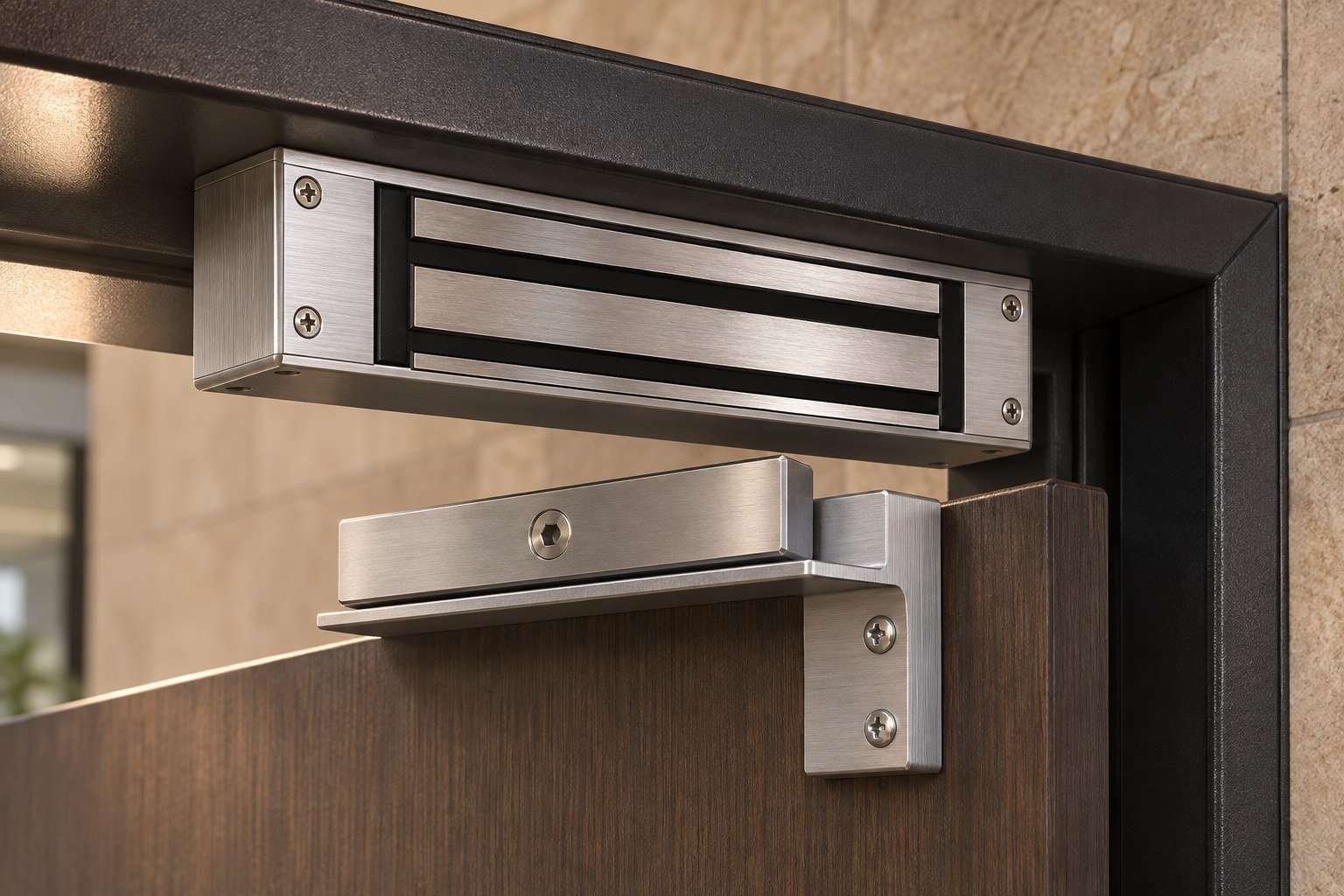
A magnetic door lock, also called a maglock, EM lock or electromagnetic lock, is one of the most common locks in access control. You see it at the top of office doors, glass entrances and server rooms across the UAE. It is simple, strong and has almost no moving parts. This guide explains how a magnetic lock works, how it connects to your access control system, what holding force means and what to check for fire safety before you install one.
What is a magnetic door lock?
A magnetic door lock has two parts:
- The electromagnet: a coil wound around a steel core, usually fixed to the door frame header. When current flows through the coil, it becomes a strong magnet.
- The armature plate: a flat steel plate fixed to the door. When the door closes, the plate sits against the magnet.
While the magnet has power, it holds the plate and the door stays shut. When the access control system cuts the power, the magnetic field collapses and the door opens with a light push or pull. There is no latch or bolt to wear out, which is why magnetic locks are popular on busy doors.
Most access control maglocks run on low-voltage DC power, commonly 12 V or 24 V. Check the rating on the lock and match it to the power supply and controller output.
How a magnetic lock works in an access control system
On its own, a maglock only holds or releases. The decisions come from the rest of the system:
- Reader or biometric terminal. A user presents a card, fingerprint, face or mobile credential.
- Door controller. The controller checks the user’s access level and time zone. If access is allowed, it switches a relay that cuts power to the lock for a set time.
- Exit device. On the inside, an exit button or request-to-exit sensor releases the door for people leaving.
- Door contact. A door position sensor tells the controller whether the door is actually closed, so it can raise an alarm if the door is forced or held open.
Our door controllers switch the lock relay and log every event, and you can choose the credential from our fingerprint access control and face recognition terminals ranges, or use cards from our RFID card guide. For the actual connections between reader, controller, lock, exit button and power supply, see our access control wiring diagram.
Holding force and lock grades
Holding force is the pull a magnetic lock resists before the door separates from the magnet. Suppliers usually quote it in pounds (lbs) or kilograms, and you will often see ratings such as 600 lbs or 1,200 lbs, or 280 kg and 500 kg, in the market. Pounds and kilograms are easily mixed up in product listings, so always check which unit a rating uses.
The American standard for electromagnetic locks, ANSI/BHMA A156.23, groups locks into three grades by minimum tested holding force:
| ANSI/BHMA grade | Minimum holding force | Approx. in kg-force |
|---|---|---|
| Grade 1 | 1,500 lbf | about 680 kg |
| Grade 2 | 1,000 lbf | about 450 kg |
| Grade 3 | 500 lbf | about 225 kg |
The standard also tests cycles, strength and finish, so a graded lock gives you more than a single number. Not every lock on the market carries a BHMA grade. If a lock has no grade, ask for the manufacturer’s test data.
Real holding force depends on installation. A plate that is misaligned, painted, dirty or fixed too rigidly will hold less than the rated value. Most armature plates are mounted with a rubber washer so they can sit flat against the magnet.
Types of magnetic locks
Surface-mounted maglocks
The most common type. The magnet is fixed to the underside of the frame header on the push side of the door, and the plate is fixed to the door. Single and double-door versions are available, and they suit most single-swing wooden, metal and aluminium doors.
Mounting brackets
Doors are not all the same, so maglocks are often fitted with brackets:
- L and Z brackets for doors that open away from the magnet side or where the frame is too narrow.
- U-brackets and glass-door kits for frameless glass doors, where the plate cannot be screwed into the door.
Shear locks
Shear locks are built into the frame and door so they are not visible. They suit doors where appearance matters or where a surface lock would be in the way. They need more precise installation than a surface-mounted maglock.
Useful options
Depending on the model, a magnetic lock may offer an LED status indicator, a lock status output that reports whether the plate is properly held, and a built-in time delay. A lock status output is worth having on important doors, because it tells the controller the door is not only closed but actually locked.
Fail-safe and fail-secure: where maglocks fit
A magnetic lock is fail-safe by nature: it needs power to lock, so it releases when power is removed. That makes it easy to connect to a fire alarm. The opposite is fail-secure: the door stays locked when power is lost.
| Lock type | Power loss behaviour | Typical use |
|---|---|---|
| Magnetic lock | Fail-safe only (releases) | Office doors, glass entrances, many egress doors |
| Electric strike | Fail-safe or fail-secure, depending on model and setting | Doors with a mechanical lock or panic bar |
| Electric drop bolt | Fail-safe or fail-secure, depending on model | Glass and double-swing doors |
If a door must stay locked during a power cut, for example a store room or cash office, a fail-secure lock or a backed-up power supply is usually the better choice. If people must always be able to leave freely, a fail-safe magnetic lock is often the simpler option.
Fire safety and emergency exit rules
Because a maglock holds the door until power is cut, it must never trap people. Fire codes deal with this directly. For example, NFPA 101, the Life Safety Code, sets conditions for electrically locked egress doors, including:
- A sensor on the egress side that releases the lock when someone approaches.
- A clearly marked manual release device near the door that cuts power to the lock directly, independent of the access control electronics, and keeps it unlocked for at least 30 seconds.
- Automatic release when the fire alarm, sprinkler or fire detection system activates, staying released until the system is reset.
- Automatic release on loss of power to the lock or the sensor.
In the UAE, fire and life safety requirements are set by the UAE Fire and Life Safety Code of Practice and approved by the Civil Defence authority in each emirate. Your consultant or fire contractor will confirm what applies to each door. In practice this usually means a fire alarm interface relay that cuts power to the maglocks, a break-glass or emergency release unit at each controlled exit, and a tested hand-over before occupancy. In Dubai, access control and security systems are also regulated by the Security Industry Regulatory Agency (SIRA).
How to choose a magnetic door lock
- Door type and swing. Wooden, metal, aluminium and frameless glass doors need different brackets. Note which side the door opens to.
- Single or double door. Double doors need a double maglock or two singles.
- Holding force. Match it to the risk and to the door’s strength. A very strong lock on a weak door simply moves the weak point to the door.
- Monitoring. Choose a lock status output for sensitive doors.
- Environment. Most maglocks are for indoor use. For doors exposed to heat, humidity or dust, choose a model rated for those conditions.
- Power supply. Use a supply rated for the total lock current, and decide whether you need battery backup.
- Fire alarm link. Plan the interface with the fire alarm system and emergency release before the ceiling is closed.
Common magnetic lock problems and fixes
- Door does not hold firmly: check plate alignment, clean both faces and make sure the plate can move slightly on its washer. Measure the voltage at the lock, not at the power supply.
- Door does not release straight away: some magnets keep a small residual hold after power is cut. Check the plate and the lock’s suppression components, and confirm the relay is actually cutting power.
- Lock buzzes or hums: usually a sign of an unsuitable or unstable power supply. Use a regulated DC supply matched to the lock.
- Door releases by itself: look for loose terminals, a faulty exit button or a power supply that drops out under load.
Magnetic door lock prices vary with holding force, brackets, monitoring features and the amount of installation work, so the most accurate way to budget is a short site survey.
Magnetic door lock FAQs
Is a magnetic door lock secure?
A correctly sized and installed magnetic lock is very hard to force open, because the full surface of the magnet holds the armature plate. Its weak points are usually elsewhere: a poorly placed exit sensor, an exposed cable or a power supply that someone can switch off. Good installation and monitoring matter as much as the holding force.
What happens to a magnetic lock in a power cut?
A magnetic lock needs power to stay locked, so it releases when power is lost. Many sites add a power supply with battery backup so the door stays secure during short outages, while still releasing on fire alarm or emergency release. Agree this behaviour with your consultant before installation.
What holding force do I need?
It depends on the door and the risk. For most internal office doors a medium holding force is enough, while main entrances, server rooms and doors facing public areas usually get a higher-rated lock. Use the manufacturer’s tested rating, and the ANSI/BHMA grade if the lock has one, rather than a marketing number.
Can I fit a magnetic lock on a glass door?
Yes. Frameless glass doors normally use a magnetic lock with a U-bracket or a special glass-door kit, because you cannot screw the armature plate into the glass. Check that the bracket suits the glass thickness and the way the door swings.
Magnetic lock or electric strike: which is better?
Neither is better in every case. A magnetic lock is simple, strong and releases instantly, which suits many egress doors. An electric strike works with the door’s mechanical lock and can be fail-secure, which suits doors that must stay locked during a power cut. Many buildings use both.
Get the right magnetic lock for your doors
We supply and install complete door access control across Dubai, Abu Dhabi and the rest of the UAE: locks, readers, controllers, exit devices and power supplies, connected to the fire alarm where required. Tell us how many doors you have, what they are made of and who needs access, and we will recommend the right lock for each one. Contact our team for a site survey and quotation. You can also browse our full range of access control systems.